
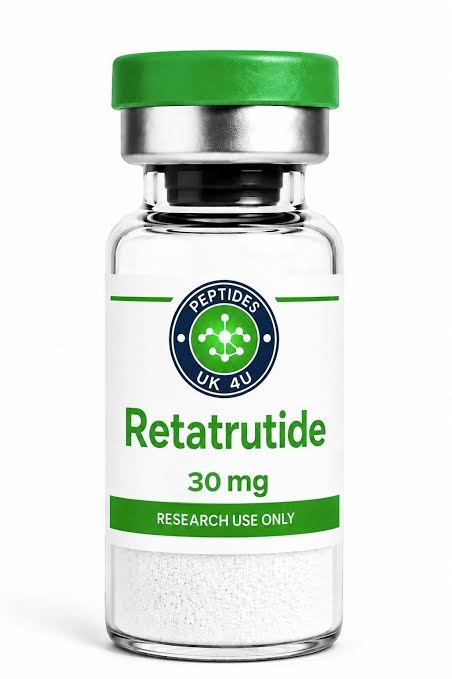
Retatrutide is an investigational triple receptor agonist targeting GIP, GLP-1, and glucagon receptors, developed by Eli Lilly. It is not currently approved in any country and remains in clinical development for obesity, type 2 diabetes, obstructive sleep apnea, and knee osteoarthritis .
Core Identity
| Attribute | Detail |
|---|---|
| Molecular Class | Synthetic peptide; triple agonist of GIPR, GLP-1R, and GCGR |
| CAS Number | 2381089-83-2 (free acid) |
| Molecular Formula | C₂₂₁H₃₄₂N₄₆O₆₈ (free base) |
| Molecular Weight | Approximately 4731.33 (free base) |
| Half-Life | Approximately 6 days, supporting once-weekly subcutaneous dosing |
| Appearance | White to off-white lyophilized powder |
Mechanism of Action
Retatrutide activates three distinct incretin and metabolic hormone receptors:
-
GIP receptor: Retatrutide shows greater potency at the human GIP receptor than native GIP (8.9-fold higher) . GIP enhances glucose-dependent insulin secretion and regulates lipid metabolism .
-
GLP-1 receptor: Retatrutide is less potent than native GLP-1 at this receptor (2.5-fold lower) . GLP-1 signaling enhances insulin secretion, delays gastric emptying, and increases satiety .
-
Glucagon receptor: Retatrutide is less potent than native glucagon (2.9-fold lower) . Glucagon receptor activation may enhance energy expenditure and lipid metabolism, distinguishing retatrutide from dual GLP-1/GIP agonists .
In vitro binding data: EC₅₀ values for human GCGR, GIPR, and GLP-1R are 5.79, 0.0643, and 0.775 nM, respectively .
Clinical Development Status
Retatrutide has completed Phase 2 trials and is undergoing Phase 3 trials (TRIUMPH program). Key reported efficacy data:
-
Phase 2 (48 weeks, obesity without diabetes): Mean weight reduction of up to 24.2% at the 12 mg dose .
-
Phase 3 TRIUMPH-1 (80 weeks, obesity without diabetes): Mean weight change of −17.6% (4 mg), −23.7% (9 mg), and −25.0% (12 mg) versus −3.9% with placebo .
-
Phase 3 TRIUMPH-OSA (80 weeks, obstructive sleep apnea): Significant reductions in apnea-hypopnea index versus placebo, with mean weight reductions of −12.5% to −22.2% depending on dose and diabetes status .
Safety Profile (from Clinical Trial Data)
The most common adverse events are gastrointestinal (nausea, diarrhea, vomiting, constipation, dyspepsia, abdominal pain) . Serious warnings from available product labels include pancreatitis, allergic reactions, gallbladder disease, and hypoglycemia risk when combined with insulin or sulfonylureas . These labels appear to be for compounded or research-grade products, not an approved commercial product.
Important Note
The DailyMed labels found in search results appear to be for compounded or unapproved preparations, not FDA-approved retatrutide. Eli Lilly states that retatrutide is an investigational molecule not approved in any geography . Any product claiming to be “retatrutide” for human use should be treated with extreme caution, as no legally approved pharmaceutical form exists.
Retatrutide’s core advantage in weight control is its triple receptor agonism mechanism (GLP-1 + GIP + glucagon), which, in both clinical trials and network meta-analyses, demonstrates weight loss magnitude that significantly outperforms currently marketed dual agonists (such as tirzepatide) and single GLP-1 receptor agonists (such as semaglutide). Its benefits are primarily reflected in three aspects: leading weight loss magnitude, significant fat mass reduction with relatively controllable lean mass loss, and additional improvements in metabolic indicators.
Weight Loss Magnitude: Currently the Strongest Among Incretin-Based Drugs
In the Phase 3 trial published in The Lancet, patients with obesity and type 2 diabetes experienced mean weight changes at 80 weeks of −11.9% (4 mg), −16.8% (9 mg), and −18.8% (12 mg) in the retatrutide groups, compared to only −5.1% in the placebo group. In the head-to-head TRANSCEND-T2D-2 trial, the 12 mg dose group lost an average of 20.9% of body weight, while the semaglutide (Ozempic) 2 mg group lost only 9.8%.
In Phase 2 obesity trials, high-dose retatrutide achieved weight loss of up to 24.2% at 48 weeks. A network meta-analysis including 25 randomized controlled trials ranked retatrutide first among all agents at both 6 months and 1-1.5 years, with weight loss 3.2% greater than tirzepatide at 1-1.5 years. Some reports indicate that in the TRIUMPH-1 study, retatrutide demonstrated weight loss of up to 30% at 80 weeks.
Body Composition: Predominantly Fat Mass Reduction
A Phase 2 body composition substudy in patients with type 2 diabetes showed that at 36 weeks, total fat mass in the retatrutide 8 mg group decreased by 26.1%, with a reduction of up to 10.9 kg in total fat mass and up to 0.6 kg in visceral fat. Although lean mass also decreased (up to 6.5 kg), the study authors noted that the ratio of lean mass loss to weight loss was similar to other obesity treatments, and retatrutide did not cause disproportionate additional lean mass loss despite greater overall weight loss.
It is worth noting that animal studies have shown gender differences: in female obese mice, retatrutide preserved muscle mass and strength while enhancing weight loss; in male mice, muscle mass decreased, but this was similar to the caloric restriction group. This finding still requires validation in human trials.
Additional Metabolic Benefits
Beyond weight reduction itself, retatrutide significantly improves multiple metabolic indicators. In the Phase 3 trial, HbA1c decreases in the 4 mg, 9 mg, and 12 mg groups were 1.38%, 1.50%, and 1.45%, respectively, compared to only 0.45% in the placebo group. In the Phase 2 MASLD substudy, retatrutide reduced liver fat by 42.9% to 82.4%, with 86% of participants in the 12 mg group achieving liver fat normalization. In head-to-head comparisons with semaglutide, retatrutide also demonstrated greater improvements in non-HDL cholesterol, triglycerides, and systolic blood pressure.
Important Considerations
The above data primarily come from clinical trials of the investigational drug retatrutide (developed by Eli Lilly), which has not yet been approved for marketing (planned FDA submission in Q1 2027). Gastrointestinal adverse reactions are the most common side effects, with treatment discontinuation rates due to adverse events of 4.8% and 7.9% in the 9 mg and 12 mg groups, respectively (compared to 2.7% with semaglutide). Additionally, similar to other incretin-based drugs, lean mass loss is a common concern with retatrutide, and combining with resistance training may help preserve muscle mass.